
New York State Compost Coalition Calls for $8.25 Million for Food Rescue, Composting, and Sustainable Materials Management Initiatives
Group calls for restoration of $5 million for Food Waste Reduction and a new budget line item for the Center for Sustainable Materials Management
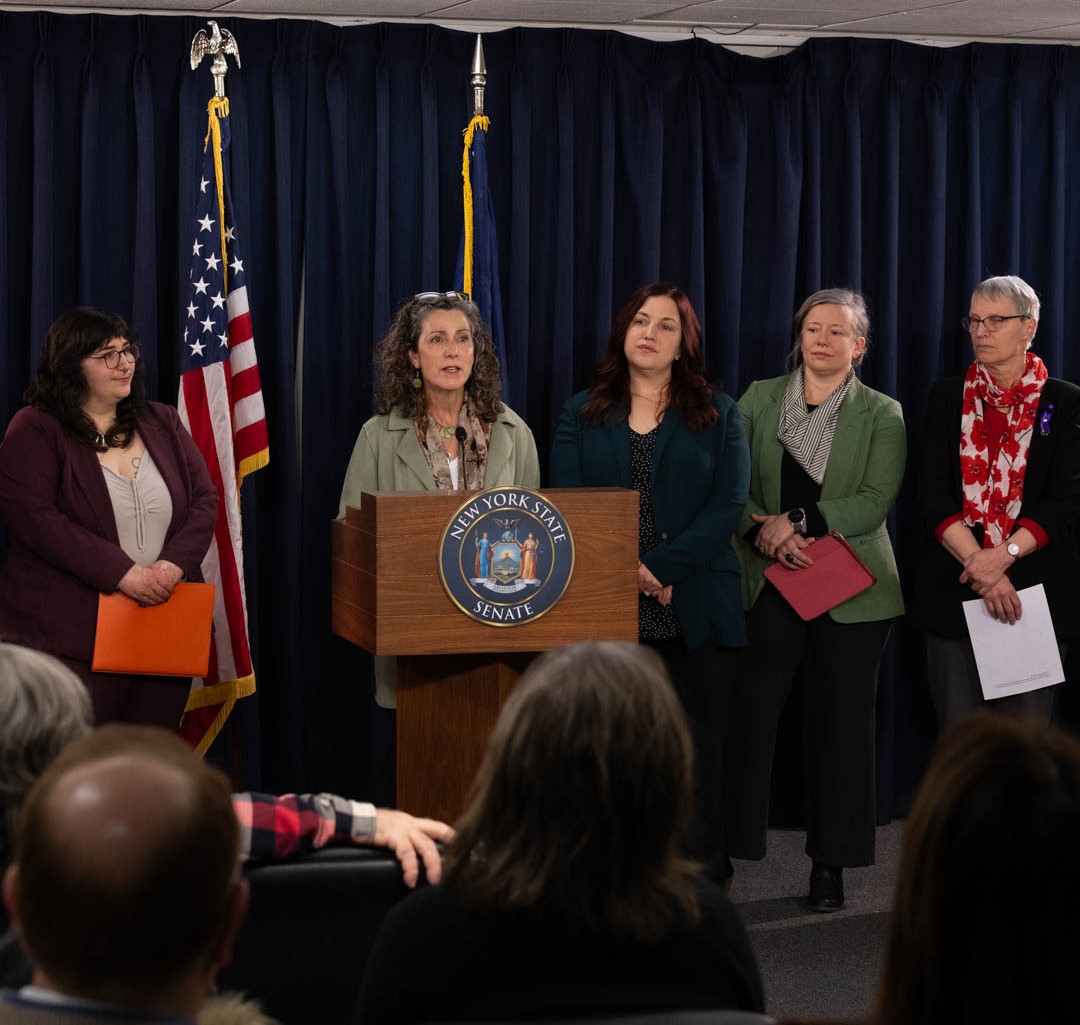
Watch the press conference here. Photos from the press conference available here.
Albany, NY – State legislators and advocates came together today to call for increased state spending on food waste reduction initiatives. Specifically, they called to restore funding for Food Waste Reduction grants within the Environmental Protection Fund (EPF) to $5 million, and for $3.25 million to establish a budget line item for the Center for Sustainable Materials Management (CSMM) at SUNY College of Environmental Science and Forestry.
Statewide, food scraps currently constitute 18-20% of solid waste according to New York State Department of Environmental Conservation (DEC) and municipal studies. Food waste in landfills releases methane, a greenhouse gas that is up to 84 times more potent than carbon dioxide at trapping heat over a 20-year period and a leading cause of climate change.
Based on 2023 DEC figures and EPA calculations, if the food waste portion of the 17.9 million tons of solid waste generated in NYS annually was composted instead of landfilled, 2.16 million tons of CO2 equivalent emissions would be avoided. When the carbon sequestration benefits of composting are factored in, the beneficial climate impact of composting NYS’s food scraps is equivalent to taking an estimated 602,000 passenger vehicles off the road each year.
Additional benefits of composting cited by Compost Coalition members include healthier and more productive topsoil, increased capacity for soil to retain water and sequester carbon, improved water quality, and decreased erosion; and economic development including job creation, and increased revenue opportunities for farmers, local businesses and municipalities.
In the previous state budget, $5 million was allocated in the EPF for the Food Waste Reduction section of NYS DEC Capital Projects. However, in her FY27 Executive Budget Proposal, Governor Kathy Hochul reduced funding for this program to $2.5 million. Advocates argue that keeping this allocation at $5 million is needed to adequately fund food waste reduction activities. They also argue that a new $3.25 million line item for CSMM will help advance New York’s efforts toward waste reduction and reuse. CSMM provides funding, educational resources, and technical assistance to entities undertaking waste reduction initiatives. The Center’s innovative research and collaborative approach provides direct support for New York State municipalities, businesses, and government agencies.
New York State has a recently expanded Food Scraps Donation and Food Scraps Recycling Law that sets goals for food waste reduction in the state. The funding requested today would support grants to municipal and nonprofit composting programs and infrastructure, expand food rescue efforts, and strengthen compost markets, enabling New York to meet the requirements of this law. These activities also support the state’s progress toward the emissions reduction goals outlined in the Climate Leadership and Community Protection Act (CLCPA).
“Food scrap recycling is a simple way to significantly lower greenhouse gas emissions,” said Compost Coalition legislative sponsor Assemblymember Dana Levenberg. “Diverting food waste from landfills and incinerators is a small step for households that has a large impact on our planet. And once people see how easy it is, it can quickly grow exponentially. Ensuring that communities have the infrastructure they need to help residents keep their food out of the trash is a highly impactful step we can take for relatively small amounts of money. In my former role as a town supervisor, I saw this with my own eyes when we introduced a grant funded program in the Town. At a time when the federal government is making it harder to fight climate change, we must seize this inexpensive, common-sense opportunity to start building a greener future."
“With nearly 20 percent of our solid waste being food scraps, we cannot ignore the environmental and economic costs. Restoring $5 million for Food Waste Reduction grants in the Environmental Protection Fund and investing to establish the Center for Sustainable Materials Management at SUNY ESF will help communities divert waste and reduce gas emissions. If we are serious about reducing landfill waste and fighting climate change, this is a smart and necessary investment for New York,” said Senator Rachel May.
“Between my district and Albany, I pass the State’s two largest landfills, one of which sits a few miles from my house. Here in the Finger Lakes region, we live with the reality of our waste problem every single day. Addressing the problem at its source and embracing circularity by reducing non-recyclable packaging, encouraging recycling through the bottle bill, and investing in composting infrastructure, we can turn our waste problem into a resource solution. I am proud to support the NYSAR3 package and fight for these bills this year!” said Assemblymember Jen Lunsford.
“Composting in New York State forms a critical pillar in sustainable waste diversion, and our ability to build healthy soils and address climate change,” said Dan Lilkas-Rain, President of the New York State Association for Reduction, Reuse, and Recycling (NYSAR3). “We urge the legislature to restore the crucial level of funding for composting infrastructure and food rescue, so that we can meet the requirements of the newly expanded Food Scraps Donation and Recycling Law and help ensure food security statewide. Further, NYSAR3 strongly supports the establishment of a $3.25 million line item within the EPF for funding of the Center for Sustainable Materials Management (CSMM)--a proven, vital partner in advancing New York’s circular future.”
“No edible food should be thrown away while New Yorkers are going hungry, and no food scraps should be generating methane in our landfills. By prioritizing food donation first and expanding composting access, we can tackle food insecurity and climate pollution at the same time. Restoring funding to at least $5 million will help scale these common-sense solutions and build healthier, more resilient communities,” said Katie McNamara, Deputy Executive Director of Environmental Advocates New York (EANY).
“CSMM plays a vital role in advancing New York’s circular future. We provide the research, partnerships, and hands-on support that ensure New Yorkers aren’t just inspired to act, but equipped to. Building a circular economy requires more than policy; it requires trust, coordination, and sustained commitment, and we are proud to help turn ambitious sustainability goals into measurable progress,” said Kathryn Walker, Executive Director of the Center for Sustainable Materials Management.
“New York’s cities and villages are on the front lines of environmental stewardship, working every day to build greener, more resilient communities. As the waste stream continues to grow and strain local resources, sustained state investment in waste reduction and diversion is critical. Maintaining a strong Environmental Protection Fund, including dedicated support for composting infrastructure, helps local governments expand organics diversion, reduce landfill reliance, and lower greenhouse gas emissions. Strategic investments in composting will provide municipalities with practical tools to manage waste more sustainably and move New York toward a cleaner future for all,” said Barbara Van Epps, Executive Director, New York State Conference of Mayors (NYCOM).
“Food’s highest purpose is feeding people. Surplus food is an opportunity to combat food insecurity and take climate action. Reducing food waste, diverting food to those who need it, and supporting composting are critical steps to building a healthy, sustainable food system that nourishes communities and protects our planet,” said Kate MacKenzie, Executive Director of the NYC Mayor’s Office of Food Policy.
"Landfills in the Capital Region account for nearly 100,000 tons of greenhouse gas emissions, so waste reduction represents a common sense and practical pathway to reducing a large source of New York's greenhouse gas emissions while preserving our environment. Municipalities and New York State have worked together on waste reduction practices through various initiatives and bills because the threat to our environment and impact on our communities is real. Advanced recycling would not only help reduce methane, but also reduce plastic packaging, ban lethal chemicals like PFAS, and ultimately, save taxpayers millions of dollars,” said State Senator Patricia Fahy.
“Reducing food waste is one of the most impactful steps we can take to protect our environment, and I strongly support increased state investment in food waste reduction initiatives. As a longtime food scrapper myself, I’ve seen how the combination of food scrapping and other recycling efforts can dramatically reduce the amount of waste we send to landfills and incineration. Waste reduction is a crucial part of meeting our environmental goals, which is why we must ensure that every community in New York State has access to food scrap recycling programs,” said State Assemblymember Amy Paulin.
"It is vital that funding for Food Waste Reduction be restored to help municipalities and nonprofits start or expand impactful composting programs. By establishing funding for the Center of Sustainable Material Management more municipalities and businesses throughout the state can avail themselves of resources and support to develop essential eco-efficient recycling and reuse programs," said State Assemblymember Judy Griffin.