|
|

|
For Immediate Release: February 10, 2003 |
|
||||
|
Silver, Koon Unveil Legislation to Address Wireless 911 Crisis Assembly bill continues fight to fund life-saving technology |
||||||
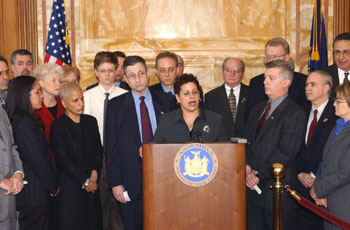
Assembly Speaker Sheldon Silver (D-Manhattan) and Assemblyman David Koon (D-Perinton) were joined today by Virginia and Henry Badillo and Barbara Dufty, whose sons were recently lost off City Island in the Long Island Sound, in announcing legislation (A.3911) aimed at creating a statewide system capable of pinpointing the location of emergency cell phone callers across New York State. Also participating in the Capitol news conference and co-sponsoring the measure were Assembly members Robert Sweeney (D-Suffolk), RoAnn Destito (D-Rome), Herman D. Farrell, Jr. (D-Manhattan) and Majority Leader Paul Tokasz (D-Cheektowaga). "It is inexcusable that after 10 years and over $200 million in collected surcharge revenue, no real progress has been made in implementing enhanced wireless emergency service." Silver said. "This bill will ensure that this money goes toward the life-saving purpose it was intended." "This is a public safety issue that impacts every single individual in this State, and the only response from the governor has been, and I'm quoting him: 'I don't think it's worthy of comment,'" said Koon. "If an enhanced 911 system had been in place, my son may have had a fighting chance," said Virginia Badillo, whose son Henry Badillo, Jr. was one of four boys lost on January 24 in a small boat off City Island in the Long Island Sound. "I am grateful for the initiative the Assembly has taken on behalf of all New Yorkers to ensure the health and safety of all families." "The fact that this system is not in place is heartbreaking," said Barbara Dufty whose son Max was also lost in Long Island Sound. "Those of us who believe in a representative system of justice believe that elected officials, as our advocates, will use all their wisdom to make difficult choices in the public arena." At issue has been the misallocation of revenue from a cellular telephone surcharge established in 1991 for the sole purpose of implementing a statewide wireless 911 emergency telecommunications system. Noting the lack of executive leadership on this issue, Koon, the bill's sponsor, called for swift passage of the bill. Calling attention to the tragic loss of the four teenage boys, partially due to an inability to pinpoint their location, Silver said the measure would expedite providing local law enforcement agencies the technology for finding cellular 911 callers desperately seeking help. This would be accomplished through immediate grants for upgrading local public safety answering points. The legislation would create the Wireless 911 Local Incentive Funding Enhancement (LIFE) Program, which would provide immediate grants to local wireless emergency dispatch centers, known as public safety answering points (PSAPs), for the development of enhanced wireless 911 systems. The proposed legislation would establish a $300 million program which would be financed through Dormitory Authority bonds. These bonds would be repaid using a portion of the existing wireless 911 surcharge monies. "The Assembly has long held that the state's failure to take every possible step to bring about enhanced 911 to New York State was simply a disaster waiting to happen," said Sweeney, who chairs the Committee on Local Governments. "If an enhanced wireless system had been in place in the recent New York City incident, it is possible the source of that tragic 911 call could have been identified, located and a tragedy averted. "We need to make sure we get this money into the hands of the people who need it as quickly as possible. Once their plan is approved, municipalities will have access to immediate funding, rather than having to wait around for reimbursement," Sweeney said. While the technology needed to identify and locate wireless callers has long been available, localities have struggled with the prohibitive costs of implementing these enhanced systems. "Other localities throughout the country have implemented this system. New Yorkers deserve no less," Destito, chair of the Committee on Governmental Operations, said. "The enactment of this measure will help localities avoid further increasing the surcharge on countywide wireless customers, which many of them did last year. Furthermore, this bill is especially important given the fact that the current generated revenue hasn't even been used toward implementing a life-saving system as it was intended to do by the state Legislature." As part of the 2002 budget process, the Assembly was instrumental in creating a local enhanced wireless 911 program and providing $20 million in funding. The measure unveiled today would build upon the existing program by increasing and accelerating funding to localities. "As a former volunteer firefighter I understand the importance of locating individuals and communicating during emergency situations. Providing the appropriate level of funding to allow for a timely response to a wireless caller is critical to an emergency service provider's public safety plan. I am pleased that the Assembly worked to create this program to better ensure the safety of our citizens" said Tokasz. "It is critical that locals receive this money immediately, especially given recent events. This financing program, using the 911 surcharge monies, is the best way to accomplish that," said Farrell, chair of the Assembly Ways and Means Committee. Farrell noted that in order to obtain the new money, localities would submit requests detailing their plans to implement the enhanced 911 technology. "The rapid rise of cellular phone use, coupled with the fact that so many New Yorkers are replacing hard lines with wireless, means the risks to the health and safety of New Yorkers only grows greater with every passing day," said Silver. "Lives are at stake." |
|
- 30 - New York State Assembly [ Welcome Page ] [ Press Releases ] |